How to Do an SEO Audit: A Practical Checklist for 2026
The exact checklist we use to audit a website before any SEO work begins, from indexation and speed to content gaps, links and AI search visibility.
Read the guideHow to earn backlinks that build real authority, what Google's spam policies say about link schemes, and the tactics that put your site at risk.
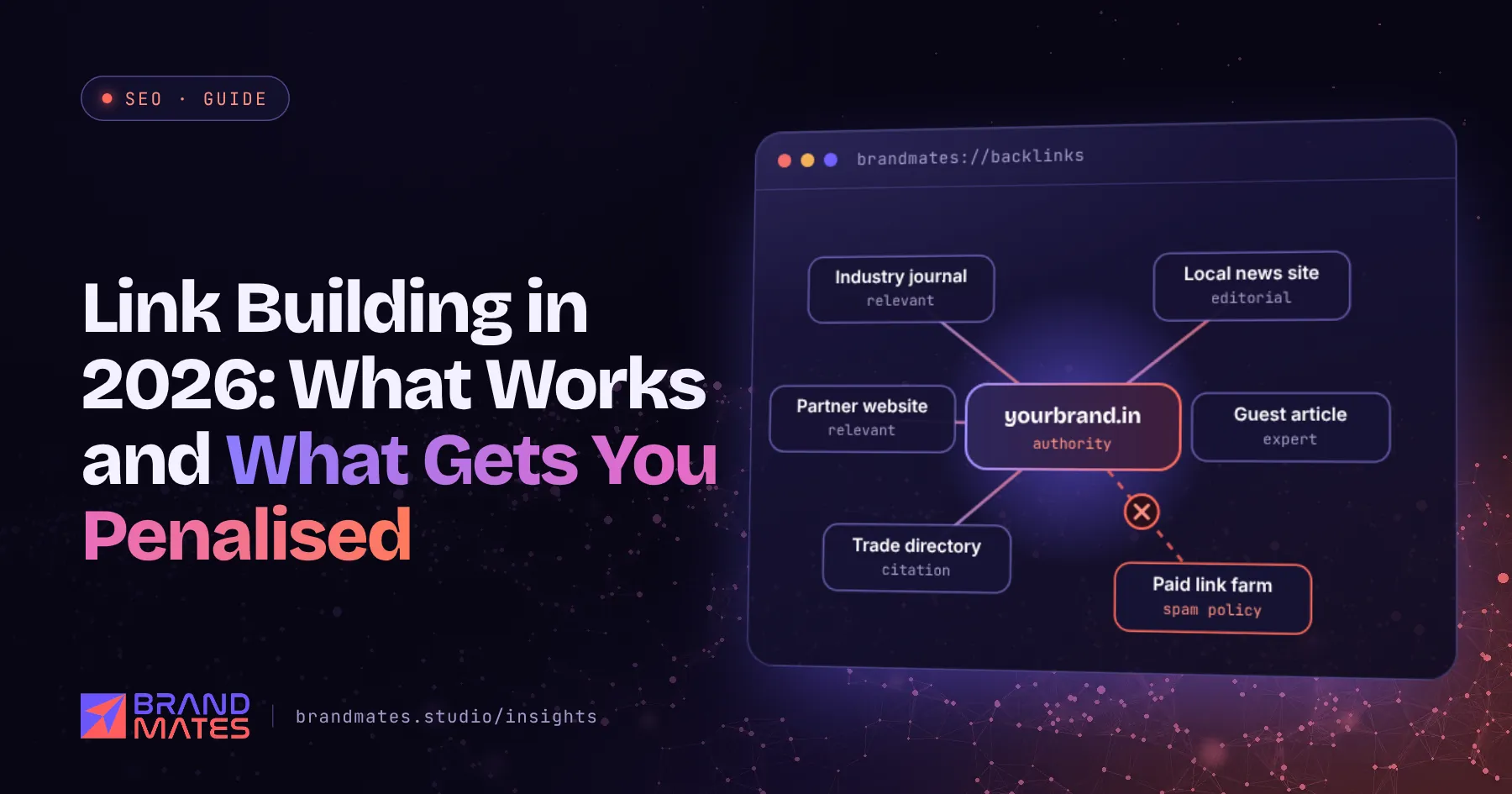
Two websites can have similar content, similar speed and similar on page SEO, and one will still rank far above the other. Very often the difference is authority, and authority comes largely from links.
Link building is the work of earning links from other reputable websites to yours. Done well, it is one of the strongest signals you can send Google. Done badly, it is one of the fastest ways to damage a site. This guide explains what works in 2026, what Google's spam policies prohibit and how to tell a valuable link from a risky one. It is part of our complete SEO guide for businesses.
Search engines treat a link from another website as a sign that your page is worth referencing. Not every link counts equally. A link from a respected, relevant website carries far more weight than dozens from unrelated or low quality ones.
Links also help in two practical ways:
Links matter for AI search too. AI assistants tend to recommend brands that are mentioned and referenced across trusted sources, which is the same footprint good link building creates. We explain that connection in entity SEO and brand mentions.
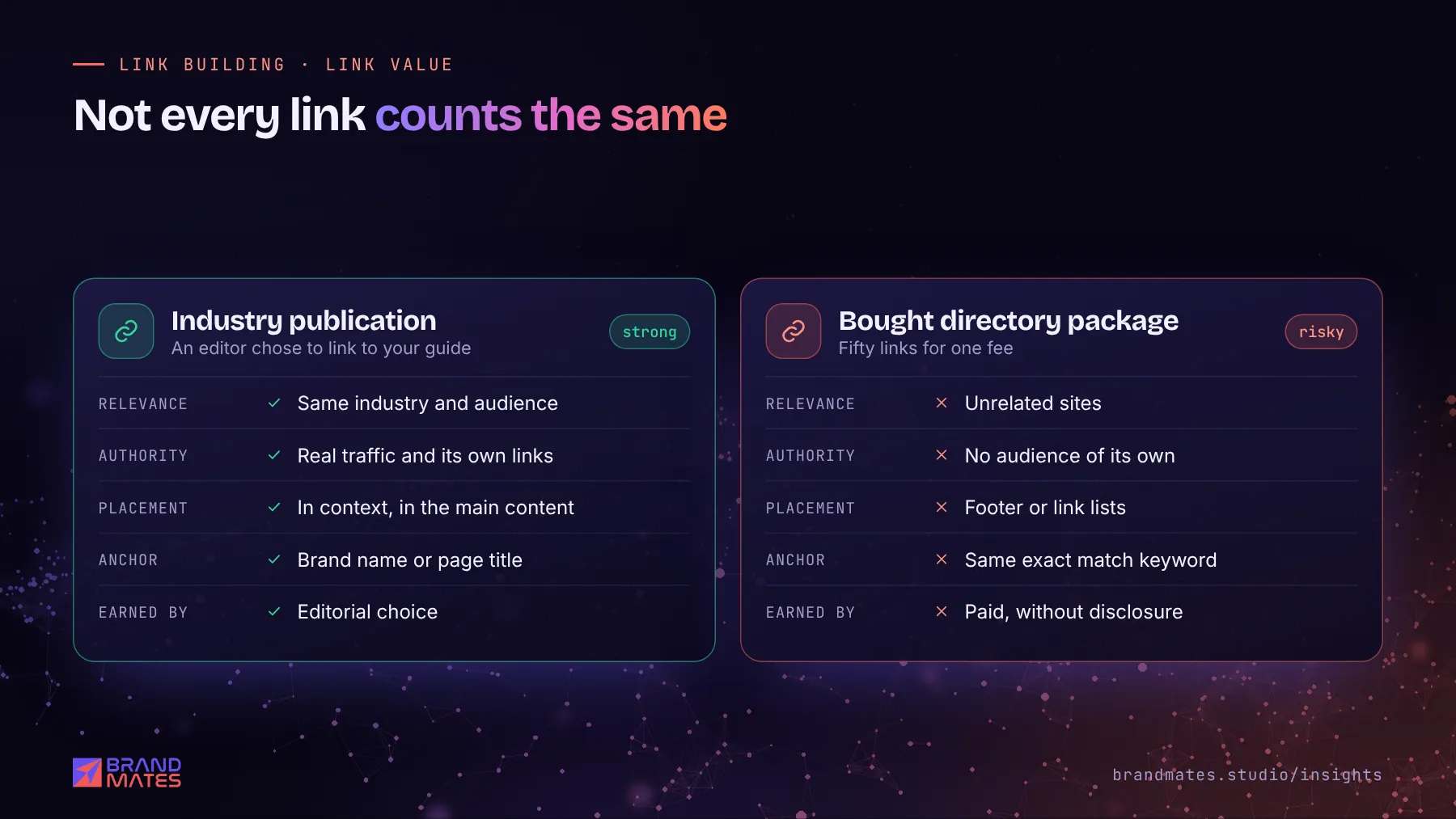
| Factor | Strong link | Weak or risky link |
|---|---|---|
| Relevance | Site in your industry, location or audience | Unrelated site with no connection to your business |
| Authority | Established site with real traffic and its own links | New or abandoned site with no audience |
| Placement | Within the main content, in context | Footer, sidebar or a page full of outbound links |
| Anchor text | Natural: brand name, page title or descriptive phrase | Repeated exact match keywords across many links |
| How it was earned | Editorial choice by the site owner | Paid, swapped or automated without disclosure |
One relevant link from an industry publication will usually do more than fifty directory links bought in a package.
Google's spam policies treat link spam, sometimes called link schemes, as a violation. Sites that take part can lose rankings through Google's automated systems or a manual action. Examples Google lists include:
If an offer sounds like "100 backlinks for ₹5,000", it almost certainly falls into one of these categories.
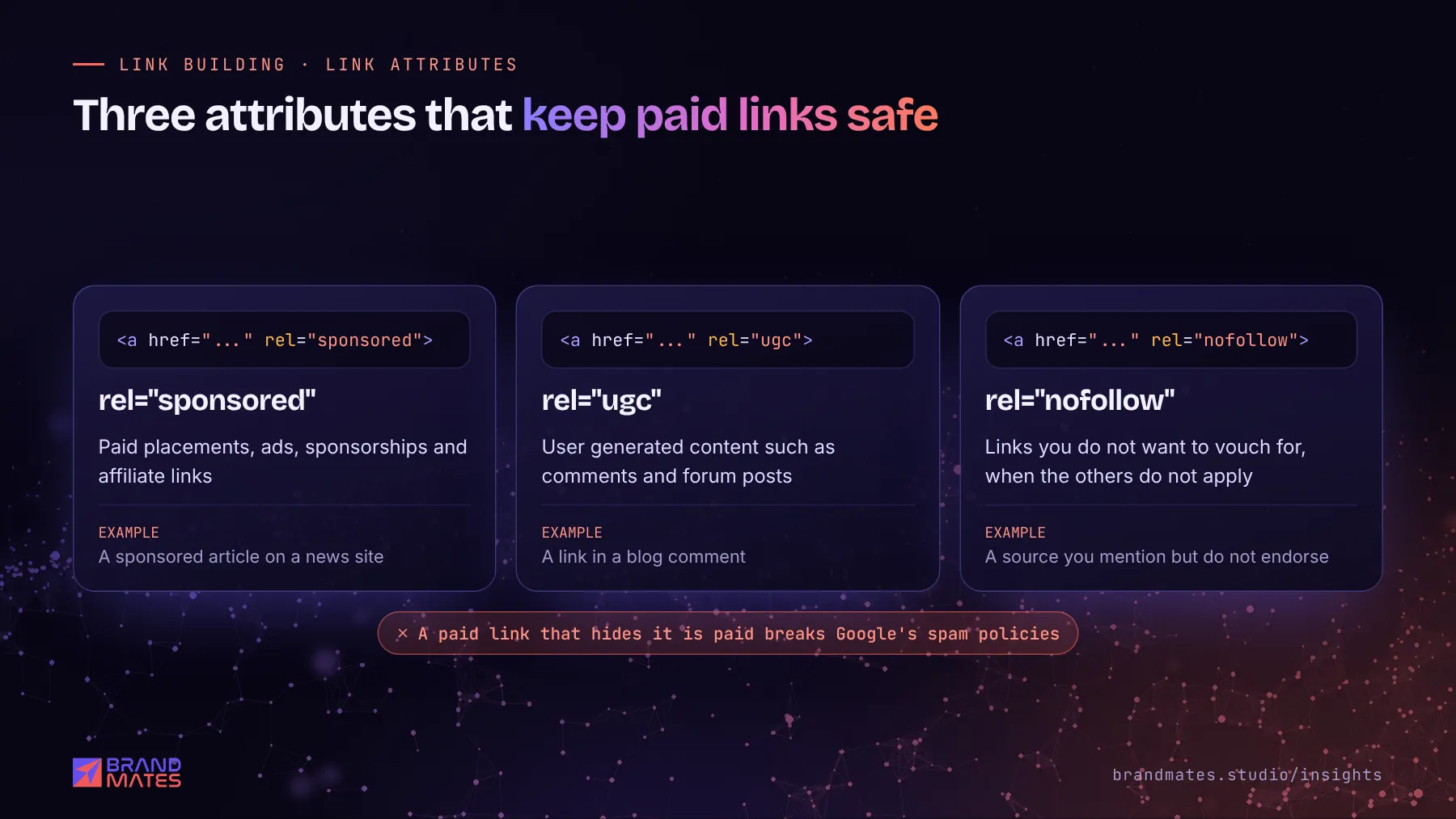
Not every link is supposed to pass ranking credit. Google supports three attributes that tell it how a link should be treated:
| Attribute | Use it for | Example |
|---|---|---|
rel="sponsored" |
Paid placements, ads, sponsorships and affiliate links | A sponsored article on a news site |
rel="ugc" |
User generated content such as comments and forum posts | A link in a blog comment |
rel="nofollow" |
Links you do not want to vouch for, when the others do not apply | A link to a source you mention but do not endorse |
Paying for a sponsored article is acceptable when the link is marked with rel="sponsored" or rel="nofollow". It can still bring brand exposure and referral traffic. What breaks the rules is paying for a link and hiding the fact that it is paid. Google treats these attributes as hints, so it may still use them for discovery.
Not sure what is holding your site back?We check technical health, content, competitors and AI visibility, then send a prioritised fix list within two working days.
The most reliable way to earn links is to publish something other sites want to reference: original data, a detailed guide, a useful calculator, industry pricing benchmarks or a strong case study. Our SEO cost in India article is an example of a page built to be referenced.
Writing a useful article for an industry blog or trade publication, with a natural link back to your site, is still effective. The key words are relevant and useful. Avoid sites that publish anything for a fee.
Pitch journalists and editors with a story: new data, an expert opinion on a trend, a notable project or a local angle. Coverage on news and industry sites builds authority and brand recognition at the same time.
Many journalists look for expert quotes. Responding with a specific, helpful answer can earn a mention and a link from a publication you could not otherwise reach.
Businesses you already work with often have pages for partners, suppliers, certified installers or case studies. Ask to be listed. These links are relevant by nature.
A small number of respected, relevant directories and trade associations are worth being listed in. Hundreds of generic directories are not.
For location based businesses, consistent listings on trusted local and industry platforms support local rankings. Keep your business name, address and phone number identical everywhere.
Search for mentions of your brand that do not link to you and ask the site owner to add a link. Also check for links pointing to pages on your site that no longer exist, and redirect them to the right page. This is especially important after a redesign, as we explain in website migration SEO.
On a drone light show company's site, link building was one part of a broader programme: keyword research by occasion and city, rewritten service pages and event content. Over six months the site earned more than 45 quality backlinks, and organic traffic grew 320%, top 10 rankings grew 185% and enquiries grew 210%. See the drone light show SEO case study.
The lesson is that links amplify good pages. They rarely rescue weak ones. Fix technical problems and content first, using our SEO audit checklist, then build authority.
If competitors have far more relevant referring domains, authority is likely your main gap.
Google's disavow tool lets you ask Google to ignore specific links. Google's guidance is that most sites do not need it, because its systems already ignore most spammy links. It is mainly useful if you have a manual action for unnatural links, or you know a large number of paid or manipulative links were built to your site in the past.
Ask any provider to show you real examples of links they have earned and the sites they came from.
Our SEO services include authority building through content, digital PR, partnerships and relevant placements, with every link reported. If you want to know whether links are what is holding your site back, request a free SEO audit and we will compare your backlink profile with your top competitors.
There is no fixed number. It depends on how many relevant, quality links the pages ranking above you have. Compare your referring domains with the top three competitors for your main keyword to see the gap.
It is not illegal, but buying links that pass ranking credit violates Google's spam policies and can lead to lost rankings or a manual action. Paid placements are acceptable when the link is marked with rel="sponsored" or rel="nofollow".
No. Nofollow and sponsored links can still bring referral traffic and brand exposure, and Google treats these attributes as hints. A natural backlink profile includes a mix of followed and nofollow links.
New links usually take weeks to a few months to show an effect, because Google needs to crawl the linking pages and the benefit builds over time. Link building works well as a steady, ongoing activity rather than a one time burst.
Links from social media profiles and posts are generally nofollow and carry little direct ranking value. Social media helps indirectly by getting your content in front of people who might link to it or search for your brand.
The exact checklist we use to audit a website before any SEO work begins, from indexation and speed to content gaps, links and AI search visibility.
Read the guide
Typical monthly SEO price ranges in India, what you get at each level, what drives the price up or down, and the red flags that signal a bad deal.
Read the guide
How to plan a redesign, platform change or domain move so you keep the rankings and traffic you already have, with a full before, during and after checklist.
Read the guideTell us where your brand needs to go. We'll come back with a free audit, a plan and a realistic timeline, usually within two working days.