SEO for Businesses in 2026: The Complete Guide
Everything a business owner or marketing team needs to understand about SEO in 2026: how Google ranks pages, what to fix first, how long it takes and how to measure it.
Read the guideHow AI assistants choose which brands to recommend, and the complete framework we use to get businesses cited by ChatGPT, Gemini, Perplexity and Google AI Overviews.

A buyer planning a corporate event opens ChatGPT and types: "Which companies do drone light shows in India, and roughly what does one cost?"
A few seconds later they have an answer. It names three or four brands, explains the price range and suggests what to ask before booking. The buyer never sees a page of search results. They shortlist from the answer and pick up the phone.
If your brand is not in that answer, you were never considered.
This is the shift AI SEO addresses. At BrandMates Studio we now run AI SEO alongside traditional search work on every account, because our clients' buyers already use both. This guide covers everything we have learned: what AI SEO is, how AI assistants decide which sources to trust, the full framework we use, how to measure it, and the mistakes that keep brands invisible.
If you are new to search optimisation in general, start with our complete SEO guide for businesses, because AI SEO is built on the same foundation.
AI SEO is the work of making your brand visible, understood and recommended inside answers generated by AI systems. That includes ChatGPT, Gemini, Perplexity, Microsoft Copilot, Claude and Google's AI Overviews and AI Mode.
It usually covers two related disciplines, which we explain in depth in our guide to AEO vs GEO:
Answer Engine Optimization (AEO) is about becoming the source an assistant quotes when it answers a direct question. If someone asks "how much does SEO cost in India", AEO is about making sure your page contains a clear, credible answer a machine can extract and attribute to you.
Generative Engine Optimization (GEO) is about being named when an assistant generates a recommendation, comparison or shortlist. If someone asks "which agencies handle both SEO and web development", GEO is about making sure your business is described consistently enough, across enough trustworthy sources, that a model includes you.
In practice the two overlap so heavily that we run them as one programme.
For twenty years the path to a purchase looked roughly the same: type a short query into Google, scan ten results, open three tabs and compare. That path still exists, but a second one now runs beside it.
Three things make AI search different:
There is no page two. An assistant typically names a handful of brands. Ranking sixth in Google still earns some clicks. Being left out of an AI answer earns nothing.
Questions are longer and more specific. People type keywords into Google but ask assistants full questions with context: budget, location, use case, deadline. The brands that get named are the ones whose content answers specific questions clearly.
Visitors arrive already convinced. When someone clicks through from an AI answer, the assistant has already explained who you are and why you fit. These visitors behave more like referrals than cold traffic.
Google itself has moved in this direction. AI Overviews now sit above the regular results for many queries, which changes how many people click through at all. We cover what that means for your traffic in our breakdown of Google AI Overviews and their impact on clicks.
No AI company publishes a ranking formula, but the mechanics are well understood. When an assistant answers a question that needs current or specific information, it typically does three things:
Every step has a requirement. To be retrieved, your page must be crawlable and indexed. To be extracted, it must state facts plainly. To be cited and recommended, your brand must look credible and consistent across the web.
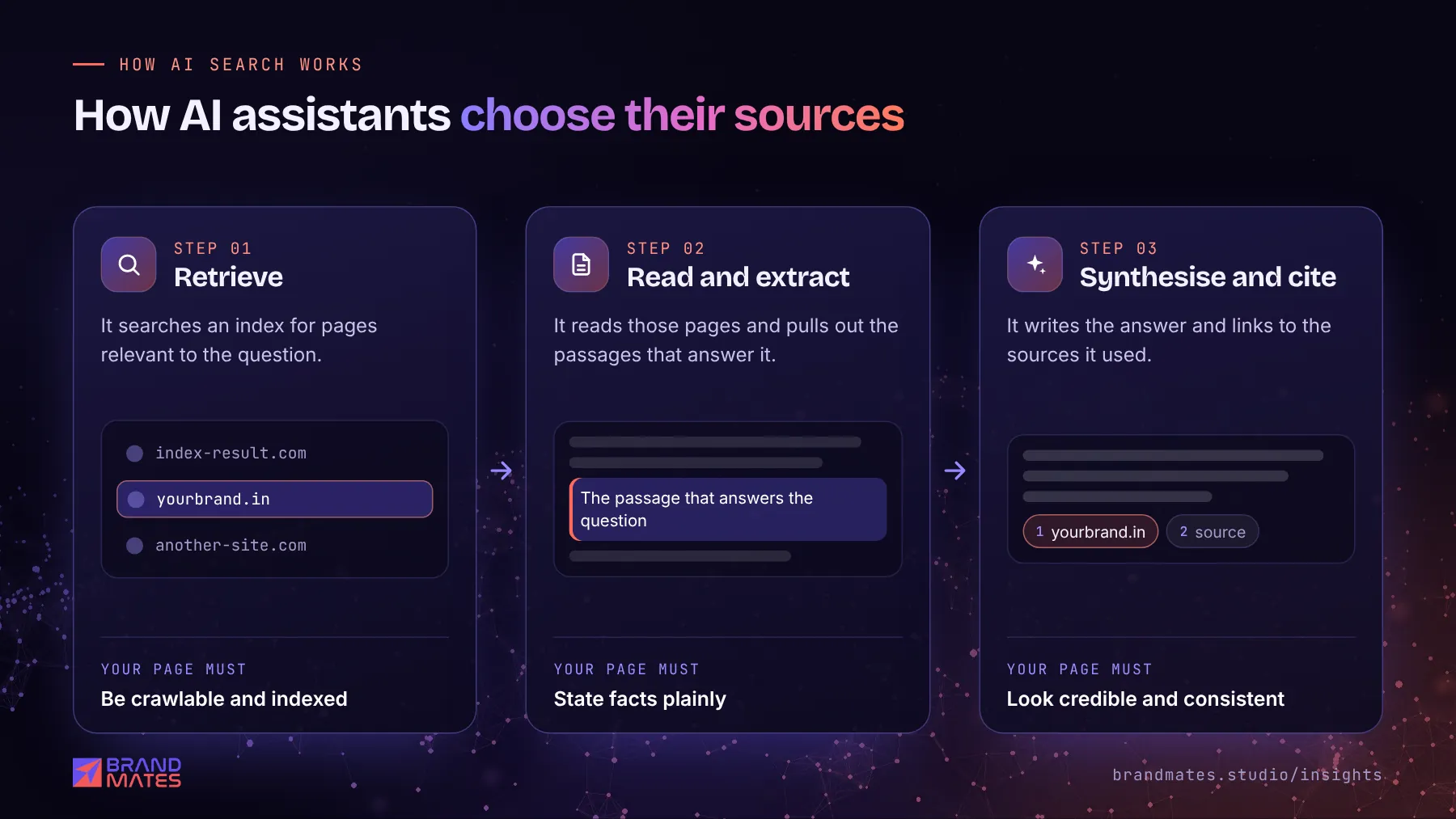
That gives AI SEO its structure. The rest of this guide follows those three requirements.
| Traditional SEO | AI SEO | |
|---|---|---|
| Goal | Rank a page in the results list | Get your brand quoted or recommended in an answer |
| Unit of success | A click to your page | A mention, a citation, then a click |
| Content style | Keyword targeted pages | Direct answers, clear facts, structured sections |
| Technical focus | Crawlability, speed, indexation | All of that, plus AI crawler access and structured data |
| Authority | Backlinks and domain strength | Backlinks plus consistent brand mentions and entity signals |
| Measurement | Rankings, organic sessions | AI referral traffic, citation checks, plus everything in SEO |
The key point: AI SEO does not replace traditional SEO. The pages that rank well in Google are very often the pages that AI assistants retrieve. Traditional SEO gets you into the pool of sources. AI SEO makes you the source that gets chosen.
Want to know if ChatGPT recommends you?We test your buyer questions across ChatGPT, Gemini, Perplexity and AI Overviews, then show you exactly what to fix.
Across the accounts we manage, brands that get named by AI assistants share five characteristics.
Assistants favour pages that state facts plainly: what the business does, where, for whom, at what price range and with what result. A service page that opens with three paragraphs about passion and excellence gives a model nothing to quote. A page that opens with "We perform drone light shows for weddings and corporate events across India" gives it exactly what it needs.
We go deeper on structure, formatting and examples in our guide on how to write content AI assistants quote.
Schema markup such as Organization, Service, Product, LocalBusiness and FAQPage tells machines in a standard format what each page is about. Of all the AI SEO work we do, structured data is the change that most often moves a brand from invisible to cited. See exactly what to add in our guide to schema markup for AI search.
Many sites unknowingly block AI crawlers in robots.txt, or hide key content behind scripts that crawlers cannot read. If a crawler cannot access the page, the page does not exist for that assistant.
The same name, address, phone number, services and description on your website, Google Business Profile, directories, social profiles and press mentions. When sources contradict each other, a model has less reason to trust any of them. This is the foundation of entity SEO, which we treat as a core part of AI visibility.
Links, citations, reviews, industry directories, guest articles and press coverage all signal that a business is real and relevant. This is the same authority building that has always mattered in SEO, and our guide to safe link building in 2026 covers how to do it without risk.
This is the sequence we run on every new account. Each step builds on the one before it.
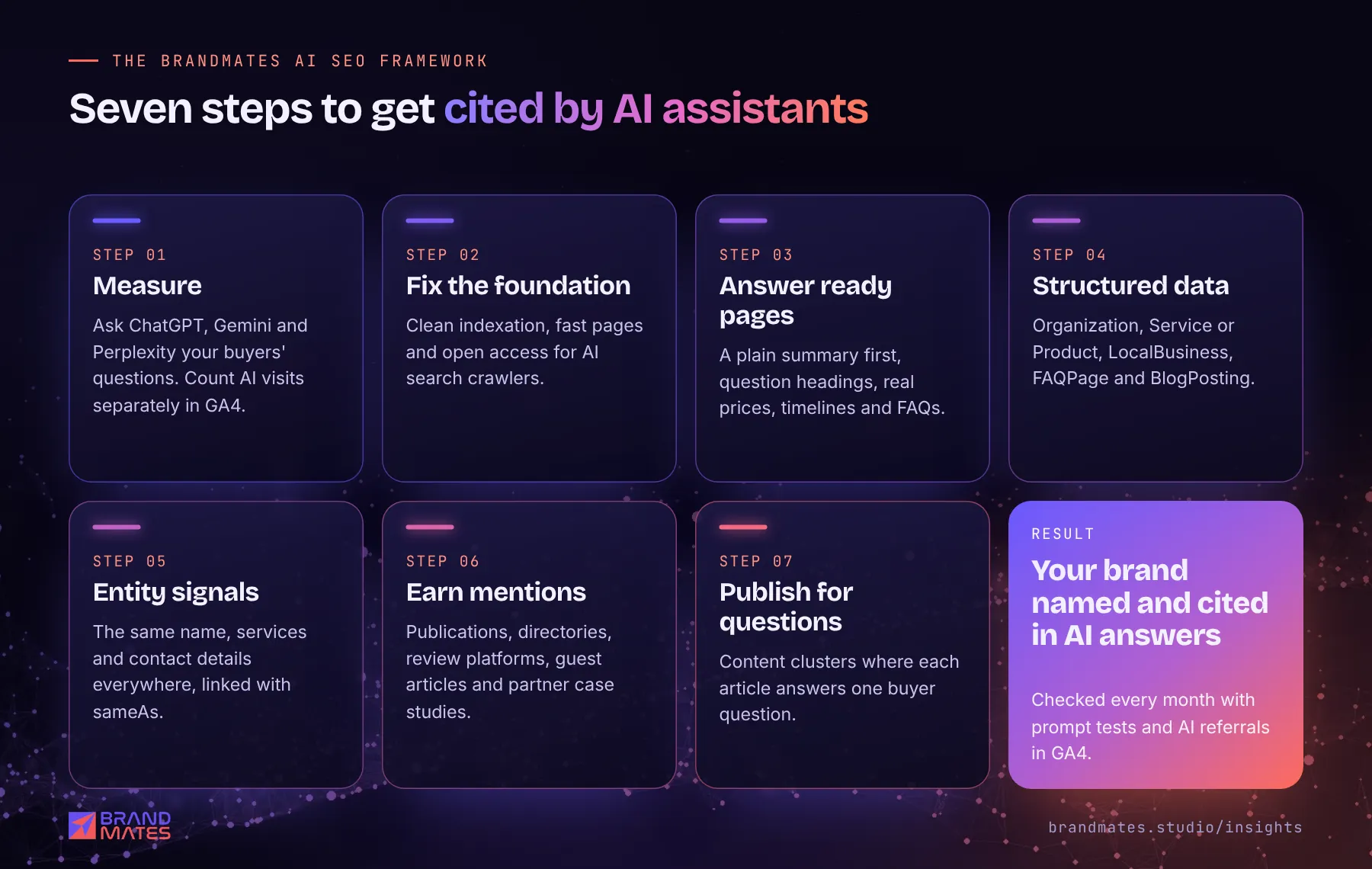
Before changing anything, find out where you stand. Ask ChatGPT, Gemini and Perplexity the questions your buyers ask, and record which brands get named and which pages get cited. Our step by step guide on how to check if ChatGPT recommends your brand includes a prompt list and a simple tracking sheet.
At the same time, set up analytics so AI visits are counted separately. Our guide to tracking ChatGPT and AI traffic in GA4 shows how to build a custom channel in about ten minutes.
AI visibility depends on the same technical health as traditional search: clean indexation, fast pages, mobile usability and no crawl errors. Work through our technical SEO checklist first.
Then check AI crawler access. These are the user agents most worth knowing:
| Crawler | Operated by | What it does |
|---|---|---|
OAI-SearchBot |
OpenAI | Indexes pages for ChatGPT search results |
ChatGPT-User |
OpenAI | Fetches pages when a ChatGPT user asks for them |
GPTBot |
OpenAI | Collects content for model training |
PerplexityBot |
Perplexity | Indexes pages for Perplexity answers |
ClaudeBot |
Anthropic | Collects content for Claude |
Google-Extended |
Controls use of content for Gemini training. It does not affect Google Search or AI Overviews |
Blocking training crawlers is a business decision some publishers make. Blocking search and retrieval crawlers, such as OAI-SearchBot and PerplexityBot, removes you from those answers entirely. For most businesses that want to be recommended, allowing them is the right default.
You may also have heard of llms.txt, a proposed file that describes your site for AI tools. It is a low cost addition, but treat it as an extra rather than a lever: Google has confirmed it does not use llms.txt for Search. We explain the full picture in what llms.txt actually does.
Start with the pages that matter most commercially: homepage, service pages, product or collection pages, and location pages. For each one:
At minimum: Organization on the homepage, Service or Product on each offering, LocalBusiness if you serve specific areas, FAQPage where you have questions and answers, and Article or BlogPosting on content. Validate everything with Google's Rich Results Test and the Schema Markup Validator.
Audit how your business is described across the web. Align your name, description, services and contact details everywhere. Add sameAs links in your Organization schema pointing to your official profiles. Correct outdated listings.
Assistants lean on sources with strong reputations: established publications, industry directories, review platforms and well known community sites. Guest articles, expert commentary, case studies published by partners and genuine reviews all add to the picture. Perplexity in particular shows its sources openly, which makes it a useful test bed; see how to get cited by Perplexity.
Build content clusters around the questions your buyers ask at each stage. This guide is itself the centre of one such cluster. Every supporting article answers one specific question and links back here, which helps both search engines and AI systems understand what we know about.
AI can help with drafting, but publishing raw AI output is a mistake. Google's guidance focuses on whether content is helpful, not how it was produced, and we cover the details in does Google penalise AI content.
A drone light show company. Buyers in this category search by occasion and city, not by brand name, and the website was close to invisible for those searches. We rebuilt keyword research around occasion and location, rewrote service pages to answer the questions buyers ask, added structured data, created event focused content and earned more than 45 quality backlinks. Over six months, organic traffic grew 320% and website enquiries grew 210%. In one recent month, AI assistants sent 23 visitors to the site, from zero before the work began. Read the full drone light show SEO case study.
A smart TV brand on Shopify. Organic search brought in 172 users a month. We fixed collection and product page structure, mapped keywords across page types, added product and FAQ schema and wrote answer ready copy. In Google Analytics 4, comparing August 2026 with February 2026, organic search users grew to 3,286 and organic search now delivers 95% of all users. See the Shopify SEO case study.
A drone survey and geospatial company. Its buyers are tender driven and research vendors carefully, increasingly through AI tools. We built the technical foundation on Wix, configured AI crawler access and NLWeb, and wrote service content around procurement questions. See the geospatial AI SEO case study.
In Google Analytics 4, create a custom channel for AI referrals from sources such as chatgpt.com, perplexity.ai, gemini.google.com and copilot.microsoft.com. Track sessions, engagement and conversions from that channel every month.
Manually, run a fixed set of buyer questions through the main assistants once a month and record whether your brand is named and which page is cited. It is simple, but it is the most direct measure available.
In Search Console, watch impressions and clicks for long, question style queries. Growth there is often an early sign your answer content is working.
Commercially, track enquiries by source. AI referral visitors often arrive pre qualified, so conversion rate matters more than volume.

Treating AI SEO as a separate project. Teams bolt on an AI strategy while the site still has crawl errors and thin content. Fix the foundation first.
Writing for machines instead of people. Stuffing pages with questions makes them worse for readers, and assistants are increasingly good at recognising low value content. Clear writing for your buyer is also what machines extract most easily.
Chasing tools instead of fundamentals. New AI visibility tools appear every month. Some help with tracking, but none replace accurate content, structured data and authority.
Making claims nobody can verify. "The best" or "the leading" gives an assistant nothing to check and a buyer nothing to trust. Specific, checkable facts carry far more weight.
Not measuring it. If AI referrals are not tracked, nobody can tell whether the work is paying off.
Every article below answers one specific question from this guide in depth:
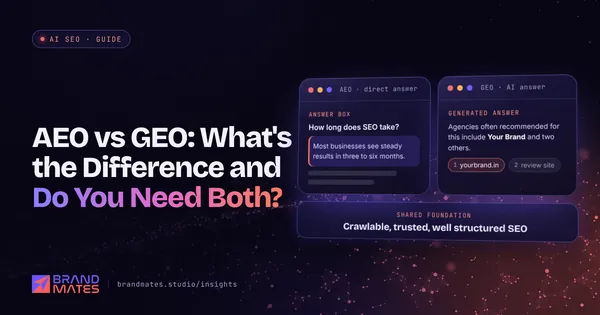 AEO vs GEO: what's the difference and do you need both?
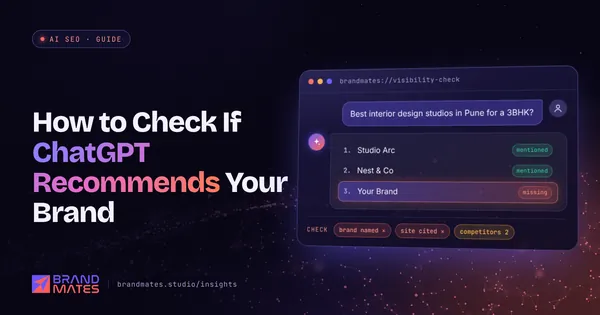 How to check if ChatGPT recommends your brand
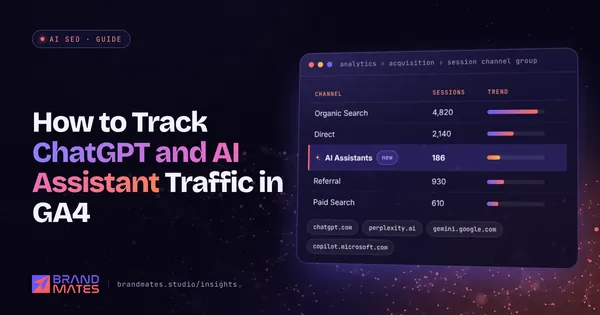 How to track ChatGPT and AI assistant traffic in GA4
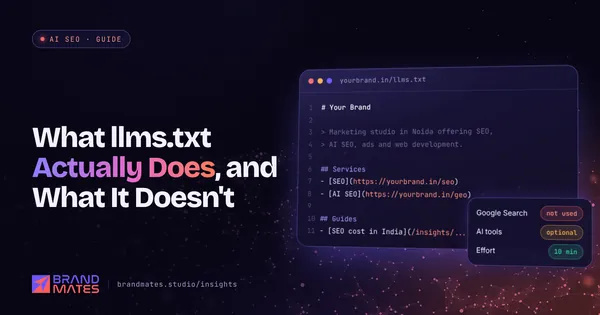 What llms.txt actually does, and what it doesn't
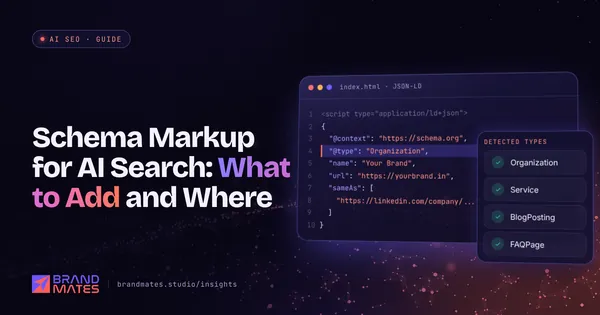 Schema markup for AI search: what to add and where
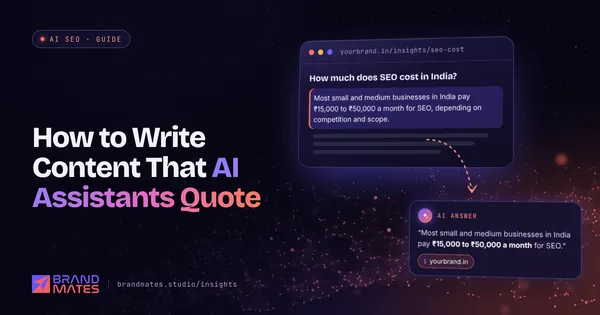 How to write content that AI assistants quote
 Google AI Overviews: what they mean for your traffic
 How to get your brand cited by Perplexity
 Entity SEO: how brand mentions build AI visibility
 Does Google penalise AI content? What's allowed in 2026
AI SEO is the work of making your business visible and recommended inside answers from AI assistants such as ChatGPT, Gemini, Perplexity and Google AI Overviews. It combines clear, factual content, structured data, crawler access and consistent brand information across the web.
It builds on regular SEO rather than replacing it. Technical health, quality content and backlinks still matter. AI SEO adds a focus on direct answers, structured data, AI crawler access and consistent entity signals, so your brand is quoted and recommended, not just ranked.
Technical fixes and structured data can take effect within weeks, once pages are recrawled. Being recommended consistently usually takes three to six months, because it depends on authority and mentions that build over time. Our guide on how long SEO takes explains the timeline factors in detail.
Yes. Visits from ChatGPT, Perplexity, Gemini and Copilot appear in Google Analytics 4 as referral sources. You can group them into a custom AI channel to track them separately every month.
It is optional. Some AI tools may read it, but Google has confirmed it does not use llms.txt for Search. Allowing AI search crawlers in robots.txt, adding structured data and writing clear content matter far more.
Yes. We run SEO and AI SEO as one programme, covering technical fixes, answer ready content, structured data, entity signals, authority building and monthly AI visibility tracking. Explore our AI SEO services or request a free SEO and AI visibility audit.

Everything a business owner or marketing team needs to understand about SEO in 2026: how Google ranks pages, what to fix first, how long it takes and how to measure it.
Read the guide
Typical monthly SEO price ranges in India, what you get at each level, what drives the price up or down, and the red flags that signal a bad deal.
Read the guide
The exact checklist we use to audit a website before any SEO work begins, from indexation and speed to content gaps, links and AI search visibility.
Read the guideTell us where your brand needs to go. We'll come back with a free audit, a plan and a realistic timeline, usually within two working days.